 Big Rock Interactive
The Battle Britain Won But Regretted
The Battle of Bunker Hill, June 17, 1775
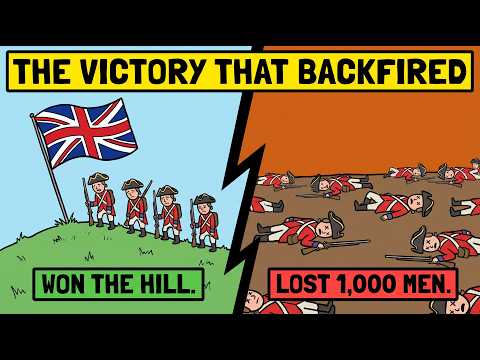
Britain won the battle. So why did it feel like a warning sign? Here's what really happened at the Battle of Bunker Hill.
In June 1775, colonial militia built a fort overnight outside Boston. The British attacked it head on, three times. This is the true story of the fight, the twist behind its name, and why it changed the American Revolution forever.
Quick facts
- When
- The colonists fortified the hill overnight on June 16, 1775. The battle was June 17.
- Where
- The Charlestown Peninsula, just north of Boston
- Colonial side
- Colonel William Prescott held the hill. The militia had very little ammunition.
- British side
- General Thomas Gage commanded in Boston. General William Howe led the attack.
- Result
- The British took the hill after three assaults
- Casualties
- Around 1,000 British and around 450 colonial
In this episode
Each line opens that moment on YouTube.
- 0:00The twist nobody expects
- 0:49Boston under siege
- 2:00The plan
- 3:06Meet the key players
- 4:16The British respond
- 5:38First assault
- 6:28Second assault
- 7:40Running out of ammo
- 8:29Third assault
- 9:29Aftermath
- 10:45Why it mattered
Myth vs. what happened
The myth
The Battle of Bunker Hill was fought on Bunker Hill.
What happened
It was mostly fought on Breed's Hill. The plan was to fortify Bunker Hill, the higher hill further back from the water, but the colonists built their main position on Breed's Hill instead. It was lower, but closer to Boston, which made it more threatening to the British and more dangerous for the colonists.
The myth
A commander shouted, "Don't fire until you see the whites of their eyes."
What happened
Whether those exact words were said that way is debated. The idea was real, though. The colonists had very little ammunition and could not afford to shoot early, so they waited until the British were close and made every shot count.
The myth
The British marched straight uphill because they were foolish.
What happened
It was not random stupidity. European armies often fought in tight formations, which helped commanders control troops, concentrate firepower and keep soldiers organized in chaos. The trouble was using that approach uphill, across exposed ground, against defenders behind earthworks.
The myth
Britain won, so it was a British success.
What happened
The British took the hill, but it cost them around a thousand casualties, many of them officers, against around 450 colonial losses. Armies can replace muskets and uniforms, but experienced officers are much harder to replace. It was a terrible bargain.
The myth
The colonists lost because the militia could not fight.
What happened
They broke two British assaults. By the third, they were nearly out of ammunition and many had no bayonets, so the fight turned into close combat and the defense collapsed. They lost because they ran out of ways to shoot back, not because they lost their nerve.
Why it mattered
For Britain, Bunker Hill was a warning that this rebellion would not end with one clean victory. For the colonists, it was proof that citizen soldiers could stand against British regulars, and that the siege of Boston was serious. George Washington would soon arrive to take command of the Continental Army, and the road from Bunker Hill leads toward independence.
Who's who
- Colonel William Prescott
- Led the work on the hill overnight and was the main officer holding Breed's Hill.
- Israel Putnam
- Involved in the broader defense and one of the names closely tied to the battle.
- Dr. Joseph Warren
- A doctor and one of the most respected Patriot leaders in Boston. He held a high rank but fought as a volunteer, and was killed during the retreat.
- General Thomas Gage
- The British commander in Boston.
- General William Howe
- Led the British attack, with professional soldiers, naval support and artillery.
Learn more
Good places to read more about this topic.
- American Battlefield Trust: Bunker Hill battle facts and summary
- National Park Service: Bunker Hill Monument
- Massachusetts Historical Society: The Siege of Boston
- Book: Nathaniel Philbrick, Bunker Hill: A City, a Siege, a Revolution (2013)